Should You See Your Primary Care Doctor or a Dermatologist for a Skin Check?
Aug 25, 2026@samanthaschneidermd Your primary care doctor can absolutely do a skin check, and if you have one who does them, that is a great thing. But there are specific situations where you need to be seeing a dermatologist — if you've had a skin cancer before, if you have a lot of moles, if you have a strong family history of melanoma, or if you have a spot that's changing, bleeding, or just won't heal. And when you're looking for a dermatologist, don't just book the first one with availability. Make sure they do a true full body skin exam — scalp, between your toes, under your nails. Make sure they are board certified through the American Board of Dermatology. And don't be afraid to ask questions. A good dermatologist welcomes them. Your PCP and your dermatologist are partners in your care — not one or the other. But knowing when to level up and what to look for when you do could genuinely save your life. Save this post, share it with someone who hasn't had a skin check in years, and drop your questions below 👇
♬ original sound - Samantha Schneider, MD
If you've noticed a new mole, a changing spot, or you're simply wondering if it's time for a skin cancer screening, you may be asking yourself an important question:
Should I start with my primary care doctor or schedule an appointment with a dermatologist?
The answer depends on your individual situation—but both healthcare providers play valuable roles in protecting your skin health.
Primary Care Is a Great Place to Start
If you don't already have a dermatologist, your primary care provider (PCP) is an excellent first step.
Primary care physicians are trained to examine the skin, recognize suspicious lesions, and identify concerns that may require further evaluation. If they find something unusual, they can refer you to a dermatologist for additional testing or treatment.
Having your skin evaluated by your PCP is always better than delaying care altogether.
When Should You See a Dermatologist?
While primary care providers are an important first line of defense, dermatologists receive specialized training focused entirely on diseases of the skin, hair, and nails.
Board-certified dermatologists evaluate skin conditions every day and are trained to recognize:
- Early-stage melanoma
- Basal cell carcinoma
- Squamous cell carcinoma
- Less obvious or unusual presentations of skin cancer
- Hundreds of other skin conditions
For comprehensive skin evaluations, dermatologists offer a level of expertise that comes from years of specialized education and daily experience.
You May Benefit from a Dermatologist If You Have Higher Risk
Consider scheduling regular skin exams with a board-certified dermatologist if you have any of the following risk factors:
- A personal history of skin cancer
- A family history of skin cancer
- Fair skin
- Multiple blistering sunburns throughout your life
- Significant sun exposure
- Numerous moles or changing skin lesions
These factors may increase your risk for skin cancer and make regular professional skin checks even more important.
What Should You Look for in a Dermatologist?
If you're searching for a dermatologist, there are a few things worth considering.
Board Certification
One of the first qualifications to look for is board certification.
A board-certified dermatologist has completed a dermatology residency and passed certification through the American Board of Dermatology, demonstrating advanced training and expertise in diagnosing and treating skin conditions.
Board certification can typically be verified online.
Dermoscopy
If you're seeking skin cancer screenings, ask whether the dermatologist uses dermoscopy.
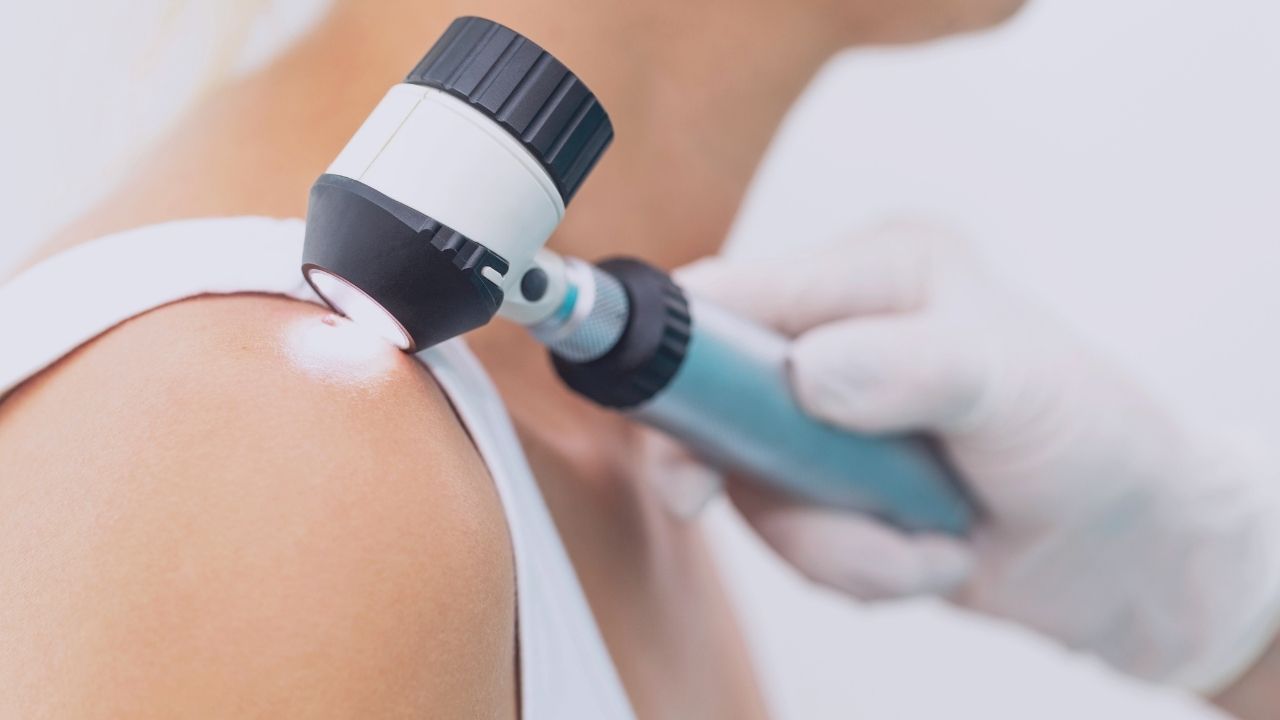
A dermatoscope is a specialized handheld device that magnifies and illuminates skin lesions, allowing dermatologists to evaluate moles and suspicious spots with greater detail. Dermoscopy has become an important tool for improving diagnostic accuracy during skin cancer examinations.
Find Someone You Feel Comfortable With
Medical expertise is essential, but so is finding a physician you trust.
Many dermatologists share educational content through their websites or social media, giving prospective patients an opportunity to learn about their approach before scheduling an appointment.
It's also perfectly reasonable to seek a second opinion if you don't feel your concerns were fully addressed or you simply don't feel comfortable with your provider.
The Bottom Line
Primary care providers are an excellent place to begin if you have questions about your skin, especially if you don't already have an established dermatologist.
However, for comprehensive skin cancer screenings, evaluation of suspicious lesions, or ongoing dermatologic care, seeing a board-certified dermatologist remains the gold standard.
If you've noticed a changing mole, have risk factors for skin cancer, or simply want peace of mind, don't wait to schedule an evaluation. Early detection remains one of the most important tools for successful treatment of skin cancer.
Follow Dr. Schneider on TikTok Instagram Facebook
Want the transcript for this video instead?
In short, primary care is a great place to start if you have concerns about your skin and you're (0:06) not already established with a dermatologist. Having somebody look over your skin is always (0:11) better than skipping it all together. They are trained to look for suspicious lesions and will (0:16) refer you out if they see something that looks concerning.
But here's the thing, dermatologists, (0:20) we do this every single day. We're specifically trained to recognize a whole range of skin (0:26) diseases including skin cancers. This includes early stage melanomas and less obvious presentations (0:32) of other types of skin cancer.
So your PCP or your primary care is a great first line of defense. (0:39) But if you have a family history or a personal history, you have fair skin, you've had a number (0:43) of sunburns in your life, then it's probably a good idea to see a board certified dermatologist. (0:50) Now the second part of the question was what do you look for when you're looking for a (0:52) dermatologist? And the first thing is you want to look for board certification.
Okay, that is a sign (0:58) that we went through dermatology residency and then we took our board exam, which is from the (1:03) American Board of Dermatology, and passed. This is something that's very easy to verify online and (1:08) then depends on what your specific needs are, what you're looking for for a dermatologist. If you're (1:12) specifically looking for skin cancer screenings and early identification of skin cancers, (1:18) then a dermatologist who uses dermoscopy is very helpful.
Okay, this is called a dermatoscope. It's (1:25) like a handheld microscope and it helps improve diagnostic accuracy when we're doing skin cancer (1:31) screenings. And the last part is really trusting your gut, getting a sense of who they are, if they (1:36) have an online presence, watching some of their videos, feeling like you get to know them, reading (1:40) about them on their bio on their website, and then honestly it may mean just trying somebody out and (1:45) seeing if you vibe.
And if it's not the right fit, then don't be afraid to get a second opinion to (1:49) see somebody else. The bottom line is your primary care is an excellent starting point, but for a (1:54) thorough specialized skin cancer screening or specific dermatology concerns, seeing a dermatologist (2:00) is the gold standard. If you have questions, make sure you drop them below.